

Article Link: https://www.nytimes.com/2019/10/08/opinion/ai-hiring-discrimination.html
Humans, in essence, cannot be programmed. The statement, “it’s only human nature”1, is a popular phrase coined to encapsulate the understanding that humans are subject to uncontrollable imperfections such as bias and discrimination. The question is, does the unconscious mind fabricate an inefficient hiring system as a result of these human informalities? If so, is there an “error-free” tool that can be implemented to eliminate such unreliable methodologies and create fair, accurate, and reliable results?
Artificial Intelligence (AI) is “an emerging category of HR technology”2 that aims to reduce recruiting time and ensure a more transparent means of candidate selection, eliminating human bias.
Arguments Against AI:
Concerns that have been raised include that AI is only an extension of human decision making, thus still susceptible to poor decision making and bias. In a recent scandal, the Amazons AI algorithm “taught itself that male candidates were preferable”3. Additionally, it has been said that eliminating the aspect of human contact in the hiring process by using AI reduces the ability to assess the “fit” of a candidate. Although these arguments are valid, they are being remedied with various technological advancements, revolutionizing the hiring process. Developments in “machine learning” has enabled AI to learn from past mistakes through experience and real-life interactions. Algorithms such as “Hindsight Experience Replay” (HER) enables AI to “look back”4, virtually teaching themselves the differences of right from wrong. This algorithm results in AI converting their failures into successes and, over time, shaping an unparalleled evaluation system. AI systems have also been designed to predict cultural fit within an organization. An AI-driven analytical platform known as “Teamscope” operates by using a 15-minute questionnaire that highlights a company’s existing and specified core values. This system provides “thousands of data points”5, emphasizing the candidates that show exceptional qualities in domains such as leadership and teamwork skills.
Arguments For AI:
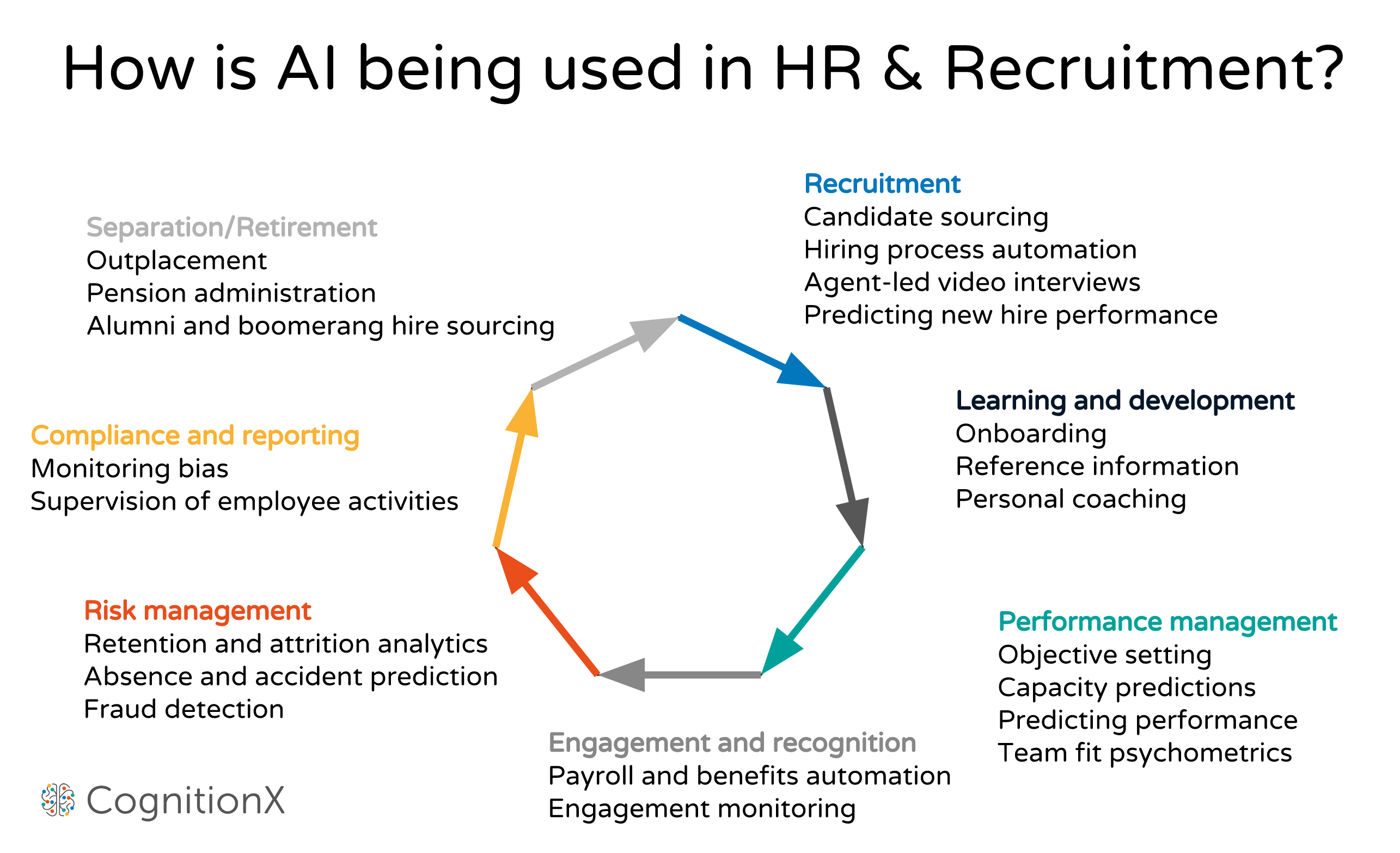
The presence of unconscious bias in recruiting and hiring has set a precedent that the protocol for evaluating job candidates is subject to inconsistencies. Several studies from PubMed Central confirmed recruiting preference’s concerning specific age, race, and sex demographics. Although there are measures to mediate these risks of prejudice, such as The Ontario Human Rights Code, which prohibit acts that involve discrimination protecting vulnerable social groups6, it is inefficient in context to preventing unintentional and unconscious bias. It was found that there is a “negative bias against women”7, “trends in hiring discrimination against African Americans and Latinos”8, and evidence of employers avoiding the hire of “older adults”9. Employers are known to limit their applicant pool from “10%-20% of total applicants who show promise (i.e., Ivey schools)”. LinkedIn’s AI platform, “LinkedIn Recruiter,” expands the applicant pool averaging 250 applicants/role, “translating into millions of applicants for a few thousand open roles”10. reports that recruiters are “75% more successful”11 in selecting the ideal candidates. Current illustrations of AI removing bias from hiring, based on decision making, is present in resume screening and digitized interviews. Through screening, AI software can separate ideal candidates versus unfavourable ones using existing employees’ experience, skills, performance, tenure, turnover rate, and social media profiles12. Digitized interviews have been said to “assess candidates’ word choices, speech patterns, and facial expressions” to influence the applicant’s suitability for the role12.
In actuality, “it is impossible to correct human bias, but it is demonstrably possible to identify and correct bias in AI”13. Embracing AI while simultaneously being cognoscente of discrepancies that may arise in AI technology is essential to the increased functionality and equity of the recruiting process. Knowing that “HR departments are chronically understaffed and underfunded”14, leveraging AI ethically and correctly can diversify and empower the workplace by providing more opportunities to more people.
References:
- (1) The African Queen. (n.d.). Retrieved from https://www.imdb.com/title/tt0043265/characters/nm0000007
- (2) AI For Recruiting: A Definitive Guide For HR Professionals. (n.d.). Retrieved from https://ideal.com/ai-recruiting/
- (3) Dastin, J. (2018, October 10). Amazon scraps secret AI recruiting tool that showed bias against women. Retrieved from https://www.reuters.com/article/us-amazon-com-jobs-automation-insight/amazon-scraps-secret-ai-recruiting-tool-that-showed-bias-against-women-idUSKCN1MK08G
- (4) Galeon, D. (2018, March 2). New algorithm lets AI learn from mistakes, become a little more human. Retrieved from https://futurism.com/ai-learn-mistakes-openai
- (5) Robson, T. (2019, 06). Leveraging AI to enhance C-suite search. Talent Acquisition Excellence Essentials, Retrieved from https://proxy.queensu.ca/login?url=https://search-proquest-
- (6) The Ontario Human Rights Code. (n.d.). Retrieved from http://www.ohrc.on.ca/en/ontario-human-rights-code
- (7) Isaac, C., Lee, B., & Carnes, M. (2009, October). Interventions that affect gender bias in hiring: a systematic review. Retrieved from https://www.ncbi.nlm.nih.gov/pmc/articles/PMC4554714/
- (8) Quillian, L., Pager, D., Hexel, O., & Midtbøen, A. H. (2017, October 10). Meta-analysis of field experiments shows no change in racial discrimination in hiring over time. Retrieved from https://www.ncbi.nlm.nih.gov/pmc/articles/PMC5642692/
- (9) Lindner, N. M., Graser, A., & Nosek, B. A. (2014, January 21). Age-based hiring discrimination as a function of equity norms and self-perceived objectivity. Retrieved from https://www.ncbi.nlm.nih.gov/pmc/articles/PMC3897397/
- (10) Polli, F. (2019, October 29). Using AI to Eliminate Bias from Hiring. Retrieved from https://hbr.org/2019/10/using-ai-to-eliminate-bias-from-hiring
- (11) The Industry-Standard Recruiting Tool: LinkedIn Talent Solutions. (n.d.). Retrieved from https://business.linkedin.com/talent-solutions/recruiter
- (12) AI For Recruiting: A Definitive Guide For HR Professionals. (n.d.). Retrieved from https://ideal.com/ai-recruiting/
- (13) Polli, F. (2019, October 29). Using AI to Eliminate Bias from Hiring. Retrieved from https://hbr.org/2019/10/using-ai-to-eliminate-bias-from-hiring
- (14) Becca, V. N. (2017, 11). How AI, machine learning and chatbots are changing the future of HCM: HR as an industry is evolving. Talent Acquisition Excellence Essentials, Retrieved from https://proxy.queensu.ca/login?url=https://search-proquest-com.proxy.queensu.ca/docview/2043507789?accountid=6180


Hi Jack,
This is a very interesting topic so thank you for bringing light to it.
As AI is beginning to be implemented in so many aspects of our day to day life, I didn’t even think to consider that it could be utilized as a Human resource technology, specifically to ensure a more transparent means of candidate selection, eliminating human bias.
I believe that everyone’s individualized political views and cognitive biases contribute to the unconscious decisions that we make in our day to day lives, and it is even more crucial to consider these aspects in talent strategy and recruiting, to ensure that all individuals have an equal opportunity at a position.
My question for you is now: Don’t you think that there is something wrong with the society that we currently live in if, we must rely on artificial intelligence and technological implementation to mask those cognitive biases that affect our usual decision-making processes?
Thanks,
Alyssa
LikeLike
Hi Alyssa,
Thank you for your reply!
To answer your question, it is very difficult to say if our reliance on technology has created a dependant and reliant culture in our society. I definitely agree that we have become more technology-based society, however, I don’t believe that this depicts our society to be faulted or unconventional. From my point of view, I just see us leveraging technological advancements such as AI to create a more fair and equitable process for recruiting. There is bias’ we cannot control as human beings and we are using tools to improve our processes. All things said I do believe we should maybe get back in touch with our roots and ensure human connection and interaction are not lost. Thank you for your insight and I look forward to hearing from you!
Kind regards,
Jack Perry
LikeLike
Hi Jack!
I really enjoyed reading your blog post and especially liked how you highlighted both sides of the argument. I wrote my blog post on the same article, so it was important for me to read other blog posts on the same article to see the situation from an alternate point of view. I noticed how you mentioned that, on multiple occasions, AI was found to be bias. In the case of Amazon, it was bias towards males. You also mentioned AI displaying a negative bias towards women, African American and Latinos. So how can we trust AI along with Machine Learning to not make these errors? Does the technology need to be consistently assessed for biases? Is this more or less efficient than using humans in the first place? One topic that consistently came to my mind regards the transparency of the AI. If AI uses Machine Learning and is constantly changing, will organizations be capable of being transparent in the hiring process? I feel as if it is very difficult to be completely transparent to potential candidates leaving room for these individuals to question the process. What do you think about the topic of transparency and AI
I believe, as you identified, AI could be used as a great screening procedure to initially separate favourable and unfavourable candidates. This way the AI could be a minor part of the hiring process but still save employees time. Perhaps this AI could read resumes and asses for qualifications rather than being fully integrated and for instance interviewing employees.
I’d love to hear back from you to see what you think about these questions!
LikeLike
Hi Jack,
I found many of the arguments in your post very intriguing and I think this emerging trend is going to have a significant impact on the future of hiring practices.
The applications and effectiveness of AI have a lot of potential to provide new insights that aren’t possible when screening and deciding on which candidates to hire. However, I think that refinements in the machine learning process that you discussed like Hindsight Experience Replay (HER) are critical to the implantation of AI and its effectiveness in employment relations.
Your challenge for an “error-free” tool to eliminate unreliable results prompts the subjective discussion of what AI is in terms of a tool in the HR department. With ubiquitous applications of AI, it’s important to narrow down the most appropriate functions and enhancements that AI will provide towards a solution. Your research clearly illustrates that AI is an effective tool to eliminate bias from hiring and reduce the business errors caused from lack of resources. While it provides insights and follows a defined system of procedures within HR & Recruitment to filter and potentially make HR departments more efficient, I think that a level of concern will be raised from the level of autonomy that corporations give AI in favor of reducing costs which could also reduce the quality of candidates making job searches feel robotic thus, taking away from a company’s potential core values.
Given that there are various approaches to the use of AI, how do you think that firms should implement this tool to yield the best results. In other words what do you feel is the most appropriate mix of human involvement in HR and recruitment?
Best,
Ryan
LikeLike