Job Security & Safety in midst of a Global Pandemic
Article: https://globalnews.ca/news/6708762/working-from-home-coronavirus/
Posted: 03/22/2020
The global economy is continuing to cascade in response to the COVID-19 outbreak, without any signs of slowing down. As a result, flustered organizations are imposing controversial resolutions unto their employees, raising concerns on their justification, delayed response, and diverse initiatives. The Canadian government has presently distributed more than 1 billion dollars in aid to reduce the impact of COVID-19 on Canadian Citizens1. The average 1-week waitlist for employment insurance (EI) has also been waived, at a 5-million-dollar expense, to assist those directly affected by COVID-19 (1). The question is, are employers upholding their part to adequately accommodate their employees, concerning compensation and employee/workplace rights, while maintaining financial feasibility.
As schools, restaurants, and small-businesses close country-wide, the preservation of sustaining some essential establishments such as grocery stores and necessary consumer goods stores seems arguable. In the context of the article, Rachel, who works for a licensed cannabis store, has been directed by employers to continue in-person work at her location2. This raises issues as COVID-19 is highly contractible regarding in-person interactions, with approximately 500 identified cases in Ontario3. Rachel is concerned as her hours have been cut from 40/week to 8/week, it will impact her ability to receive full EI as she is still coming into work. Rachel’s original EI claim will be reduced by 50 cents/dollar4. There seem to be viable alternatives, such as online delivery or pick-up. Thus the demand for an in-store presence appears questionable. Under the Employment Standards Act (ESA), employers have the responsibility to uphold the health and safety of their workers. With COVID-19 being announced as a state of emergency in Ontario5 extreme precautions must be taken, rather than prioritizing profits.
Negative COVID-19 Business Responses:
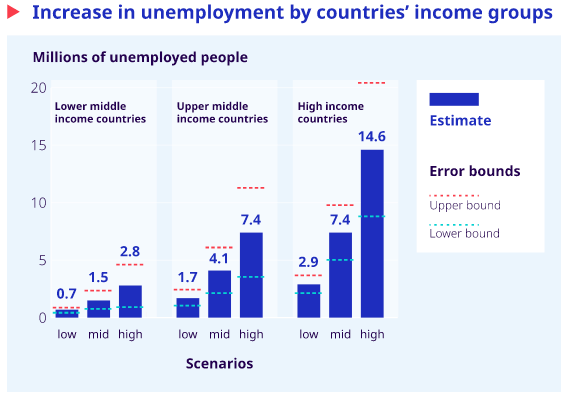
Across Canada, various businesses have had their unique response to the unexpected outbreak of COVID-19, and the Canadian federal government is receiving over 500,000 applications for EI this week raises potential concerns6. Initiatives that have sparked this uprising of EI applications is the high concentration of COVID-19-related layoffs. As of March 24th, WestJet has announced approximately half of its 14,000 employee workforce will leave the company at the beginning of April7. As the COVID-19 virus continues, these patterns of layoffs to mediate the company’s inability to withstand the volatile economic climate correlates to almost half of Canada’s workforce to be unemployed. According to an Angus Reid survey, 44% of Canadian households have lost work, in addition to 18% that anticipate losing their current source of employment8.
Reasonable COVID-19 Business Alternatives:
The government has taken significant action to help the impact COVID-19 has had on the Canadian economy and its employees/employers. In addition to this, employers and business owners have taken steps of their own to sufficiently accommodate their workforce. The Canadian Labour and Employment Law Association has put into effect a checklist to help employers navigate through the logistical difficulties COVID-19 presents. Initiatives such as appointing coordinators to track COVID-19 updates, work-from-home policies, and canceling work-related travel are being put into place to prevent the spread of COVID-19 in the workplace9. Companies such as Amazon, Apple, and Microsoft have all instituted work-at-home policies10. Deloitte is also offering incredible consultation and guidance, assisting other businesses in promoting clarity and transparency to employees11.
Amongst this precariousness and insecurity, employees and employers must stay up to date with daily reports and know their rights. Understanding the ESA, Occupational Health and Safety Act, Pay Equity Act, and Labour Relations Act all contribute to ensuring fair treatment during these times12. In doing so, employees can become effective advocators for themselves as well as their colleagues. In turn, they are structuring an informed and knowledgeable atmosphere, which encourages openness and security.
References:
- (1) Public Health Agency of Canada. (2020, March 13). Government of Canada. Retrieved from https://www.canada.ca/en/public-health/services/diseases/2019-novel-coronavirus-infection/canadas-reponse/government-canada-takes-action-covid-19.html
- (2) Bowden. (2020, March 23). Employer still not letting you work from home? How to navigate coronavirus office upheaval. Retrieved from https://globalnews.ca/news/6708762/working-from-home-coronavirus/
- (3)Gabbyrodrigues. (2020, March 23). Ontario announces 78 new COVID-19 cases, total hits 489 active coronavirus cases. Retrieved from https://globalnews.ca/news/6717321/ontario-coronavirus-covid-19-cases-march-23/
- (4) EI Sickness and Work-Sharing Agreements: Ken Hardie: Your member of parliament for Fleetwood-Port Kells. (2020, March 12). Retrieved March 25, 2020, from https://khardie.liberal.ca/news-nouvelles/ei-sickness-and-work-sharing-agreements/
- (5) kerribreen1. (2020, March 21). Coronavirus: 500,000 Canadians have filed for EI this week. Retrieved from https://globalnews.ca/news/6707529/coronavirus-500000-canadians-employment-insurance/
- (6) Jung, A. (2020, March 21). Facing layoffs during the COVID-19 crisis? Know your rights. Retrieved from https://bc.ctvnews.ca/facing-layoffs-during-the-covid-19-crisis-know-your-rights-1.4862413
- (7) Reynolds, C. (2020, March 24). WestJet announces layoffs for nearly 50% of staff due to COVID-19, Air Canada reduces pilots. Retrieved from https://globalnews.ca/news/6725938/westjet-air-canada-layoffs-covid-19/
- (8) mahamabedi1. (2020, March 25). 44% of Canadian households report lost work amid COVID-19 pandemic: poll. Retrieved from https://globalnews.ca/news/6726202/coronavirus-canada-job-loss-poll/
- (9) MacMillan, S., & Jordan Kirkness & Susan MacMillan. (2020, March 23). COVID-19 Checklist for Canadian Employers. Retrieved from https://www.labourandemploymentlaw.com/2020/03/covid-19-checklist-for-canadian-employers/#more-3930
- (10) Lufkin, B. (2020, March 13). Coronavirus: How to work from home, the right way. Retrieved from https://www.bbc.com/worklife/article/20200312-coronavirus-covid-19-update-work-from-home-in-a-pandemic
- (11) Moir, J. (2020, March 12). COVID-19: Practical workforce strategies that put your people first. Retrieved from https://www2.deloitte.com/ca/en/pages/finance/articles/covid-19-practical-workforce-strategies-that-put-your-people-first.html
- (12) Ministry of Labour. (n.d.). Workplace Rights. Retrieved from https://www.labour.gov.on.ca/english/atwork/workplacerights_fs.php